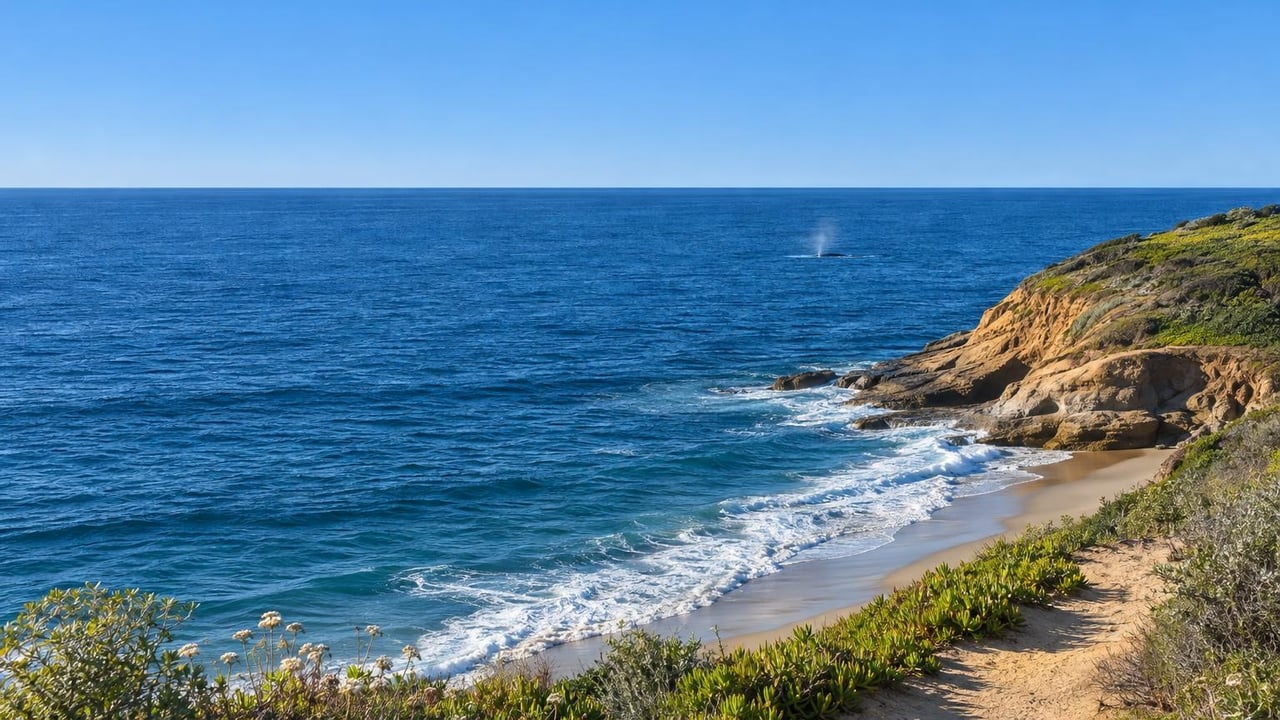
On Saturday, Nov. 21, the Newport Harbor whale fleet ran nine tours and logged 22 humpback whales, 1,000 common dolphins and 135 Pacific white-sided dolphins. The shared sightings log kept by Davey's Locker, Newport Landing and Newport Coastal Adventure shows gray whales just once this fall. That was Nov. 4, when two passed through on a day that also had three humpbacks and 250 common dolphins.
The gray whale migration does reach the water off Crystal Cove, but it hasn't really started yet. The best gray whale weeks off Newport Coast come late, on the trip north. Last winter's log puts them in late February and March, with the mothers and calves close to the bluffs. The ocean between now and then has a different cast, and a resident who books a boat or walks a bluff trail by month will see more than one who books for "whale season."
Late November and December are humpback weeks
Humpbacks and dolphins fill most of the fall log. On Nov. 12 the fleet counted 25 humpbacks and 2,200 common dolphins on nine tours. On Nov. 3 it logged 204 pilot whales and 22 humpbacks. Orcas showed up twice in late October, 20 of them on Oct. 24 and seven the next day. Davey's Locker says dolphin superpods of 1,000 or more are a regular sight on its trips.
Newport Landing's own schedule page says the gray whale migration runs off the Orange County coast from late December through April. If you have family in town this week or next, the boats are a humpback-and-dolphin outing, and a good one.
The winter schedule is easy to plan around. From November through February, Newport Landing runs three departures every day, at 9 a.m., noon and 2:30 p.m. Its posted adult fare is $41 on weekdays and $45 on weekends and holidays. Seniors and children 3 to 12 pay $33 and $37, and toddlers pay $8. Davey's Locker posts the same winter departure times. Both check-in offices are on the Balboa boardwalk, at 309 Palm St. and 400 Main St. The boat decides which one you use, so the operator asks guests to arrive 60 minutes early and get directed from there. Leaving Newport Coast, the same FAQ says to set your GPS to avoid ferries. The shortest-distance route can send you to the wrong side of the harbor and onto the Balboa Island auto ferry.
Sightings aren't guaranteed, and Newport Landing doesn't refund a trip that comes back without them. It does issue a 50% off return ticket when a trip sees no whales, and a $7 return ticket when it sees no marine mammals at all. Cancellations made at least 24 hours ahead get a full refund or a new date. With the November log looking like it does, that $7 ticket is unlikely to come into play.
January is when grays pass, mostly out of sight
The southbound gray whales start arriving in December. Crystal Cove Conservancy says southbound grays are usually seen in Southern California from December through February. The number passing and the number you see from a Newport boat are two very different figures, though.
NOAA Fisheries runs its official count from shore on the central California coast. From Jan. 5 to Feb. 13, 2026, its observers counted an estimated 2,563 whales, and their best single day was 158 on Jan. 19. On that same Jan. 19, the Newport fleet logged six gray whales across eight tours. Six was also January's best day in Newport. The fleet matched it on Jan. 4, Jan. 23 and Jan. 24, and several January days had no gray whales at all.
The American Cetacean Society's Los Angeles chapter helps explain the gap. It has run a shore-based count on the Palos Verdes Peninsula since 1984, and its observers now work from the Point Vicente Interpretive Center. In its 2024–2025 season summary, the group notes that most grays take offshore routes there. It counted 130 southbound gray whales for that season, against 485 northbound. Its peak southbound week was Jan. 25–31, 2025. Going south, most of the whales pass farther out. January boats still find plenty of dolphins: the fleet logged 2,000 common dolphins on Jan. 15, 2026, along with four grays and two humpbacks.
Mid-February, the direction changes
Crystal Cove Conservancy says that around mid-February, gray whales can be seen going either way. Some are already heading back to Alaska while others are still on their way to Mexico, so a north-swimming whale and a south-swimming whale can turn up on the same day. ACS-LA set its official turnaround date for the 2024–25 season at Feb. 21.
The Newport log changes right on time. Starting Feb. 7, 2026, gray whales show up on almost every logged day: 14 on Feb. 15, nine on Feb. 20 and 16 on Feb. 22. On Feb. 28 the fleet logged 11 grays and 4,500 common dolphins. The next day, March 1, it logged 23 grays and 4,965 common dolphins.
March is the gray whale month off Newport Coast
The biggest gray whale day in the 2026 log was Saturday, March 14. That day 18 tours went out and counted 53 gray whales, plus 103 bottlenose dolphins and 350 common dolphins. No day in January came close. ACS-LA's northbound peak fell in the same week the year before, with its highest northbound count on March 15, 2025.
Northbound whales also stay close to shore, which helps anyone watching from land. According to Crystal Cove Conservancy, gray whales follow the coastline the whole season. On the way north, mothers with newborn calves "stick especially close to shore for protection." The Conservancy says that makes for "spectacular whale watching from any of the beaches and bluffs of Crystal Cove." It also suggests watching which way a heart-shaped blow is heading.
March brings other big whales as well. Fin whales start showing up in the same log entries as the grays, nine of them on March 26 and 17 on April 1. By mid-April the fins take over, with 23 on April 18 and 21 on April 19. The last gray whales in the spring log were six on May 6. If you want a festival, Dana Point's Festival of Whales is scheduled for March 5–7, 2027, a short drive down Coast Highway.
Where to watch from shore
From Newport Coast, the obvious place is Crystal Cove's bluff trail, which the Conservancy names, along with the park's beaches, as a place to see gray whales from shore. One change from past winters is the Pelican Point P2 beach access trail. California State Parks said on Oct. 15, 2026, that a bluff failure near Pelican Point damaged it, and the trail and its beach access are closed until further notice. Our Crystal Cove access guide covers how each entrance works this season.
Closer to the harbor, Lookout Point in Corona del Mar is a small park overlooking the Newport Harbor entrance and the open ocean. Orange County Outdoors says whales and dolphins can be seen from there with some patience. Parking is on the street, there's no fee, and there are shade trees and grass for a picnic. From Lookout Point you can also see the boats that left the Balboa boardwalk earlier in the day heading back in.
Last season's count came in higher
The whales coming south this winter are part of a population that NOAA estimated at 17,750 in its July 2026 report, a figure based on the 2025/2026 southbound migration. The prior season's estimate was 12,950, as ACS-LA reported it. NOAA called the higher number "an encouraging finding." The same report also says the recent jumps are faster than births alone can explain, so something else must be affecting the count. That could be how the survey detects whales, or a change in how the whales migrate. For someone watching from the bluff, that matters. A change in migration behavior would show up first in when and where the whales pass. That makes the daily fleet log, posted at newportwhales.com, the best guide to this particular season.
If you're weighing which Newport Coast or Corona del Mar view lines up with the March bluffs, the Annie Clougherty Team can talk you through the ocean-facing streets and enclaves, block by block. Request a private consultation.